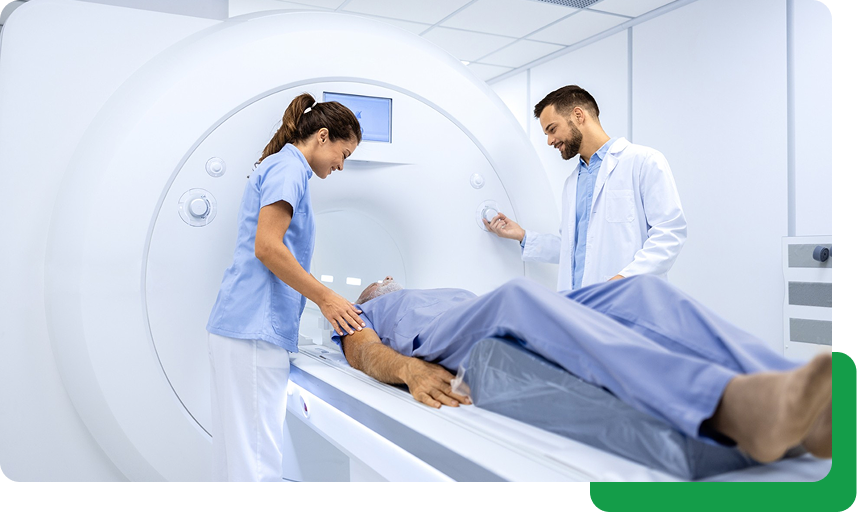
 Positron Emission Tomography (PET) is a nuclear medicine scan that uses a radioactive sugar solution to create images of how your organs and tissues function, and to identify normal vs. abnormal (cancer) cells. When the sugar solution concentrates in certain areas of the body, the PET scan picks-up the pattern of radioactivity and creates 3-dimensional images. Different colours and degrees of brightness in a PET scan image represent different levels of organ and tissue function. Cancer cells require more sugar to function, and therefore, appear brighter in a PET scan image.
To improve the accuracy of the diagnosis, we have integrated a CT (Computed Tomography) scanner. The result is a fusion of two sets of images: One that depicts the functional images of abnormal cells (PET) and the other demonstrates the structure of the tissues and organs (CT). The combination of these images will improve the physician’s ability to determine exactly where in the body the changes are taking place.